Why Vitalik Is Right: Crypto Can’t Just Be a Casino While the World Burns
06/03/2026
Vitalik Buterin’s latest comments highlight a growing truth: if crypto wants to matter, it has to do more than build casinos for speculators.
There’s something refreshing about seeing someone in crypto say out loud what a lot of people have been quietly thinking for years:
What exactly is all this technology for?
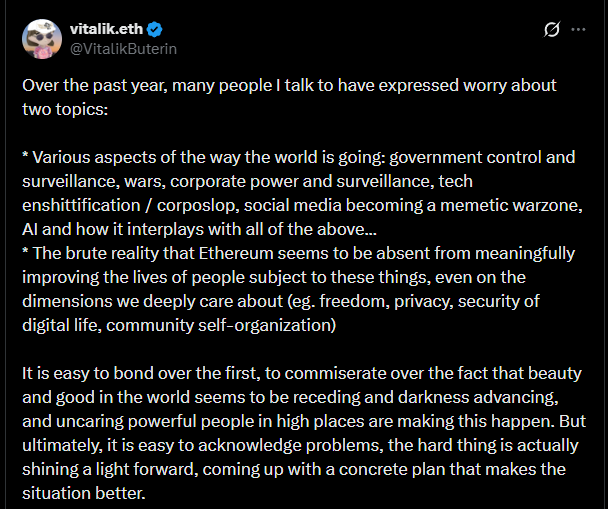
Vitalik Buterin’s recent comments hit on a tension that has been obvious for a while now. The world feels increasingly hostile, increasingly controlled, increasingly fake. Governments want more surveillance. Corporations want more extraction. Social media has turned into a machine for outrage, manipulation, and algorithmically amplified sludge. AI is accelerating all of it at once, often in ways that feel less like liberation and more like handing a flamethrower to the world’s most powerful institutions.
And in the middle of all that, crypto — especially the parts of crypto that once claimed to care about freedom, decentralization, and individual sovereignty — has spent far too much time building financial slot machines for over-caffeinated speculators.
That’s the uncomfortable truth.

For all the rhetoric about revolution, most of the industry ended up producing memecoins, leverage casinos, grifts with whitepapers, and a parade of “communities” that mysteriously disappear the second token price goes down. A lot of it has felt less like building the future and more like inventing new ways to lose rent money in 4K.
So when Vitalik talks about Ethereum needing to be part of a broader ecosystem of what he calls “sanctuary technologies,” he’s pointing at something much bigger than blockchain.
He’s pointing at the fact that people do not need more shiny apps. They need systems that let them survive power.
That distinction matters.
The real problem isn’t lack of innovation. It’s who innovation serves
We are constantly told we live in an age of incredible technological progress. That part is technically true. We have absurdly powerful tools. We have global communication, machine intelligence, open-source software, distributed systems, and computing power that would have looked like science fiction not long ago.
And yet ordinary people are not exactly feeling the utopia.
Why? Because innovation under modern capitalism tends to be pointed in a very specific direction: not toward human flourishing, but toward control, monetization, dependency, and enclosure.
That’s why so much modern tech feels rotten.
Your phone is “smart,” but increasingly locked down.
Your social platforms are “free,” but feed off your attention and behavior.
Your software gets worse while subscription prices go up.
Your digital life becomes more central to survival while also becoming more vulnerable to surveillance, deplatforming, manipulation, and platform decay.
That isn’t accidental. It’s the business model.
The left critique here is not that technology is bad. That’s baby-brain nonsense. The critique is that technology built inside systems of concentrated power will usually end up reinforcing concentrated power unless people deliberately build alternatives.
That’s what makes Vitalik’s framing interesting.
He’s not saying Ethereum can fix everything. That would be messianic tech-bro fluff, and thankfully he seems too self-aware for that. He’s saying Ethereum should be one piece of a larger stack of tools that help people carve out spaces of autonomy in an increasingly hostile digital world.
That idea has teeth.
“Sanctuary tech” is a much better goal than “number go up”
The term “sanctuary technologies” is doing a lot of heavy lifting here, but in a good way.
It moves the conversation away from speculative finance and toward something much more politically meaningful: resilience.
What kinds of technologies actually matter when institutions become predatory, platforms become extractive, and trust in centralized systems keeps collapsing?
Probably things like:
- encrypted communication
- open-source software
- local-first computing
- self-custodial money
- censorship-resistant publishing
- portable identity
- community-owned infrastructure
- hardware and operating systems that aren’t just spyware with rounded corners
That list is not purely “crypto,” and that’s exactly the point.
If Ethereum wants to matter outside its own bubble, it cannot keep acting like every human problem is secretly a liquidity problem. A better financial system matters, yes. But people are also worried about speech, privacy, autonomy, coercion, disinformation, war, platform dependence, and being slowly turned into tenants on systems they rely on but do not control.
A decentralized exchange does not solve all that.
Hell, it barely solves breakfast.
But a broader ecosystem of interoperable, user-owned, censorship-resistant tools? That starts to look more serious.
The left should not dismiss this stuff just because crypto people touched it
This is where I think a lot of left-leaning analysis has dropped the ball.
There’s a tendency in some progressive spaces to write off crypto entirely because the loudest people in the room were libertarian weirdos, finance bros, or outright scammers. And to be fair, that impression did not emerge from nowhere. The industry has done an extraordinary amount of self-sabotage. If a sector spends years screaming about freedom while launching monkey JPEGs and Ponzinomics with anime mascots, people may develop doubts. Shocking, I know.
But dismissing the underlying technology stack outright is intellectually lazy.
The left, at its best, is supposed to care about power. Who has it, how it’s exercised, and what tools ordinary people have to resist domination. By that standard, there is nothing inherently reactionary about decentralized infrastructure. In fact, under many conditions, it aligns quite naturally with left concerns around anti-monopoly politics, democratic access, privacy, mutual aid, and reducing institutional overreach.
The real question is not “Is crypto good?” That’s a useless caveman question.
The real question is: Can decentralized systems be designed to materially reduce dependence on exploitative gatekeepers?
That is a much more interesting question, and the answer is clearly: sometimes, yes.
Not always. Not magically. Not through memes and vibes and token launches with twelve layers of yield mechanics. But yes, in principle, these tools can form part of a broader politics of autonomy.
The biggest threat now is totalisation
One of the sharpest parts of Vitalik’s post is the idea of de-totalisation.
That’s a mouthful, but it points to something very real.
The danger in the modern digital world is not just that bad actors exist. The danger is that too much of life is being routed through systems where a small number of actors can exercise near-total control. A payment processor can cut you off. A platform can erase your reach. A cloud provider can decide whether your app lives or dies. A government can pressure intermediaries. An AI company can shape what millions of people see, hear, and believe.
When every layer is centralized, every conflict becomes existential.
That’s a terrible way to build a civilization.
The answer is not to fantasize about some perfect decentralized utopia where all institutions vanish and we all govern ourselves through tokens and Discord polls. That road leads directly to clown town. Human societies are messy. Coordination is hard. Institutions exist for reasons, even when those reasons later mutate into bureaucratic fungus.
But building zones of partial independence? Building systems that reduce the blast radius of centralized abuse? Building shared digital spaces that no single corporation owns and no single state can fully dominate?
That is not utopian. That is practical.
It is also increasingly urgent.
If Ethereum wants relevance, it needs to pick a side
And by “pick a side,” I don’t mean partisan branding. I mean moral orientation.
Does Ethereum want to be infrastructure for speculation, extraction, and financial nihilism?
Or does it want to become part of a real counter-infrastructure for people who need privacy, ownership, credible neutrality, and protection from institutional coercion?
Because it cannot convincingly be both.
If the ecosystem keeps rewarding useless casino behavior while occasionally posting lofty essays about public goods, people are going to keep rolling their eyes. Fairly. The gap between rhetoric and reality has been enormous.
The only way out of that is through actual usefulness.
Build tools for activists, dissidents, journalists, precarious workers, cooperatives, mutual aid networks, creators, communities under financial censorship, people in unstable currencies, and anyone else who actually benefits from infrastructure that cannot be arbitrarily shut off or enclosed.
That would be real.
That would matter.
That would also be much harder than launching the 900th tokenized nonsense machine and pretending it’s innovation because the UI has gradients.
Final thoughts
Vitalik’s post stands out because it sounds like someone looking at the world as it is, not as a pitch deck wants it to be.
The world is becoming more brittle, more manipulated, more surveilled, and more consolidated. Under those conditions, technology worth caring about is not technology that merely entertains, extracts, or optimizes ad engagement. It is technology that gives people breathing room.
That’s what sanctuary tech should mean.
Not a fantasy of escaping politics.
Not a belief that code replaces institutions.
Not another excuse for techno-feudal nonsense wrapped in the language of freedom.
It should mean building tools that make domination harder.
Tools that keep power from becoming absolute.
Tools that help ordinary people retain some agency in systems increasingly designed to strip it away.
If crypto wants to be more than a casino with a manifesto, that’s the path.
Anything less is just more corposlop with a wallet attached.